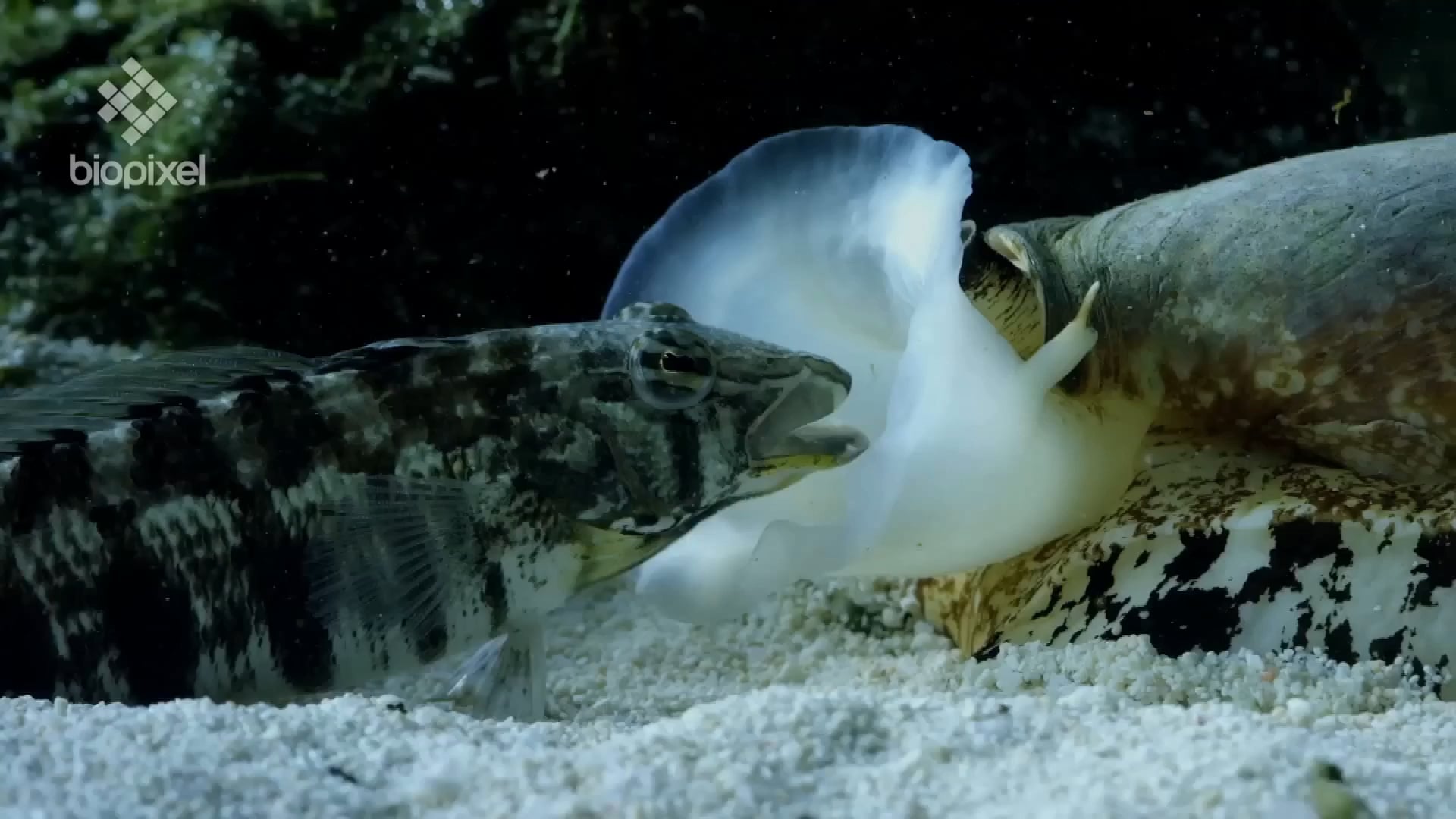
This cone snail releases insulin-like toxins into the water to induce hypoglycemic shock, causing the fish to become lethargic and sink. Then it engulfs the fish whole with its expandable mouth and rostrum. The snail then extends a long, harpoon-like radula tooth (connected to a venom gland) from its proboscis, stabs the paralyzed fish, and injects a complex cocktail of conotoxins. These conotoxins (including motor cabal and nirvana cabal peptides) rapidly cause neuromuscular paralysis, immobilizing and killing the prey within seconds. This is called the net hunting strategy.
The geographic cone snail is the most toxic of the roughly 500 known cone snail species, potent enough to kill humans, and there is currently no antivenom for its venom. [Source](https://www.youtube.com/watch?v=LZYBMJesOBQ)
KennyJapan on
reminds me of my ex wife!
Tripton1 on
“Shhhhhh, it will all be over soon, fish.”
SelfInteresting7259 on
Diabetics: WOOOOOOH FREE INSULIN
One1moretyme on
Fitting: Snail gives slow death.
kg_digital_ on
what
Kush_Reaver on
Step 1: Capture thousands of cone snails.
Step 2: Find way to harvest insulin from them without killing yourself by accident.
Step 3: Kick Pharmaceutical companies square in their balls by selling insulin at astronomically low prices.
Step 4: Use cone snails to defend yourself from the Hit-men hired by aforementioned Pharmaceutical companies.
Bodyoddyoddy_ on
So many crazy types of predators in the water. Friend got spiked by a lionfish while diving and passed out underwater
DataWeenie on
Stuff like this is soooooooo creeepy.
Relevant_Maybe_9291 on
Am I bugging or are the snails the most dangerous things in the sea? The percentages of ones that can take you out seems high
Artyom_7 on

The face hugger would also work here
Rare-Sample-9101 on
So after its feeds it can’t get back in the shell? Seems eating it is a dangerous activity
TY2022 on
Damn. Nothing like waking up in something’s stomach.
Not_an_Issue85 on
This douche has spare insulin to spray and I can’t even make my own. This is crap.
Alderhander on
Brutal, nature.
Old-Guidance6744 on
You see the eyes moving, its aware its being eaten
I sat on the toilet for too long the other day and lost use of my legs below the knee, didn’t matter how much I tried to lift my foot to walk it just wouldn’t, couldn’t feel it either except tingling.
Not having control of your body is fucking weird, losing control as you watch your death is nightmare furl
Ashamed-Land1221 on
Damn if my insulin was low and a seemingly friendly stranger shared some cookies to help me out I honestly wouldn’t expect them to then stun and eat me whole. I don’t think I’d make it as an aquatic creature, I’ll stay to my mammal caves and wooded areas.
ArkhamTight606 on
Cone Snail got that mouth game.
PowerNinja5000 on
I got stung by a cone snail a couple years ago. No clue which type. It was agonizing pain for about 5 hours and then my foot doubled in size. A few days later I couldn’t walk on it. Super fun!
RunExisting4050 on
I should call her.
TopLaugh8909 on
Damn nature, you scary!
Working_Guidance8577 on
This is how I eat hotdogs
VichelleMassage on
Everything about them is crazy. The way that they completely engulf their prey is horrific too.
fikabonds on
Fuck me nagure can be brutal sometimes. Fish was totally aware but couldnt move.
Fragrant-Anywhere489 on
When I said “deadly neurotoxin,” the “deadly” was in massive sarcasm quotes. I could take a bath in this stuff. Put it on cereal, rub it right into my eyes. Honestly, it’s not deadly at all… to *me*. You, on the other hand, are going to find its deadliness… a lot less funny.
**GLaDOS**
swampopawaho on
Looks like one of my workmates approaching a burger at lunchtime
Divers collecting Cone shells have been lethally “bitten” (stung) whilst ascending to their boat with the Cone shell in their hessian collection bag as it leans against their leg. I know of one case where a Cone snail extended the proboscis thought the mesh of the bag and injected the diver in the leg. He lost consciousness and died at the surface. Most of these shells are potentially deadly – with the Geography Cone (Conus geographus) and the Textile Cone (Conus textile) being the two most feared. The Geography Cone has killed over 35 people that we know of, with many other “drowning victims” likely being killed buy the same type of shell. Many reef explorers who know of the danger, often don’t realize they can also reach back and sting the hand even if you’re holding it by the wide base of the shell. When I’ve had to move them or pick them up, I’m always extremely mindful of where the snail is and never take my eyes off it during handling. The venom apparatus behind the radular tooth (which the snail retains in a tiny membrane sack) is forced out at high pressure when the tooth punctures its intended victim. It literally looks like a miniature garden hose under pressure. The radular tooth looks exactly like a whaler’s harpoon… (see pic). It also fires faster than a bullet.
Whilst all cone snails are venomous, many aren’t likely to kill you… though quite a few species certainly can. Even the scientists who study their venom believe that they all pose a potential threat. The Geographic Cone (Conus geographus), the Textile Cone (Conus textile), the Striated Cone (Conus striatus), and the Tulip Cone (Conus tulipa) are all considered deadly – though many others like the Banded Marble Cone (Conus bandanus) and Hebrew Cone (Conus ebraeus) are potentially capable of killing an unfortunate person. I collect Cone shells for display in my bathroom – but not from the wild. I source them from shell merchants who take all the risk. I think I have about 30 and I replace them with larger specimens from time to time.
Steel_Djinn on
That’s as wildly fucked up as star fish having a stomach they completely expel from their body after anchoring down prey beneath them dissolving them with gastric juice from the stomach then sucking the substance into the stomach and then back into their body. 👀
o-0-o-0-o on
And this is just a regular ass snail.
This is why I think people always underestimating the immortal snail
relaxyourshoulders on
These things give out free insulin? Wait till Eli Lilly hears about this.

35 Comments
This cone snail releases insulin-like toxins into the water to induce hypoglycemic shock, causing the fish to become lethargic and sink. Then it engulfs the fish whole with its expandable mouth and rostrum. The snail then extends a long, harpoon-like radula tooth (connected to a venom gland) from its proboscis, stabs the paralyzed fish, and injects a complex cocktail of conotoxins. These conotoxins (including motor cabal and nirvana cabal peptides) rapidly cause neuromuscular paralysis, immobilizing and killing the prey within seconds. This is called the net hunting strategy.
The geographic cone snail is the most toxic of the roughly 500 known cone snail species, potent enough to kill humans, and there is currently no antivenom for its venom. [Source](https://www.youtube.com/watch?v=LZYBMJesOBQ)
reminds me of my ex wife!
“Shhhhhh, it will all be over soon, fish.”
Diabetics: WOOOOOOH FREE INSULIN
Fitting: Snail gives slow death.
what
Step 1: Capture thousands of cone snails.
Step 2: Find way to harvest insulin from them without killing yourself by accident.
Step 3: Kick Pharmaceutical companies square in their balls by selling insulin at astronomically low prices.
Step 4: Use cone snails to defend yourself from the Hit-men hired by aforementioned Pharmaceutical companies.
So many crazy types of predators in the water. Friend got spiked by a lionfish while diving and passed out underwater
Stuff like this is soooooooo creeepy.
Am I bugging or are the snails the most dangerous things in the sea? The percentages of ones that can take you out seems high

The face hugger would also work here
So after its feeds it can’t get back in the shell? Seems eating it is a dangerous activity
Damn. Nothing like waking up in something’s stomach.
This douche has spare insulin to spray and I can’t even make my own. This is crap.
Brutal, nature.
You see the eyes moving, its aware its being eaten
I sat on the toilet for too long the other day and lost use of my legs below the knee, didn’t matter how much I tried to lift my foot to walk it just wouldn’t, couldn’t feel it either except tingling.
Not having control of your body is fucking weird, losing control as you watch your death is nightmare furl
Damn if my insulin was low and a seemingly friendly stranger shared some cookies to help me out I honestly wouldn’t expect them to then stun and eat me whole. I don’t think I’d make it as an aquatic creature, I’ll stay to my mammal caves and wooded areas.
Cone Snail got that mouth game.
I got stung by a cone snail a couple years ago. No clue which type. It was agonizing pain for about 5 hours and then my foot doubled in size. A few days later I couldn’t walk on it. Super fun!
I should call her.
Damn nature, you scary!
This is how I eat hotdogs
Everything about them is crazy. The way that they completely engulf their prey is horrific too.
Fuck me nagure can be brutal sometimes. Fish was totally aware but couldnt move.
When I said “deadly neurotoxin,” the “deadly” was in massive sarcasm quotes. I could take a bath in this stuff. Put it on cereal, rub it right into my eyes. Honestly, it’s not deadly at all… to *me*. You, on the other hand, are going to find its deadliness… a lot less funny.
**GLaDOS**
Looks like one of my workmates approaching a burger at lunchtime

Pretty embarrassing for that fish 😅
Insulin you say??
https://preview.redd.it/5xkauudfzv5g1.png?width=1024&format=png&auto=webp&s=cc5c4995f401b51b07b4f3a98e56ec89278e90be
considering how deadly just about everything is in the ocean, Australia is really Atlantis, is it?
https://preview.redd.it/mnnu3etjzv5g1.jpeg?width=600&format=pjpg&auto=webp&s=1cb6cfc941b95e5a60c690ba226f6bba3d12d493
Divers collecting Cone shells have been lethally “bitten” (stung) whilst ascending to their boat with the Cone shell in their hessian collection bag as it leans against their leg. I know of one case where a Cone snail extended the proboscis thought the mesh of the bag and injected the diver in the leg. He lost consciousness and died at the surface. Most of these shells are potentially deadly – with the Geography Cone (Conus geographus) and the Textile Cone (Conus textile) being the two most feared. The Geography Cone has killed over 35 people that we know of, with many other “drowning victims” likely being killed buy the same type of shell. Many reef explorers who know of the danger, often don’t realize they can also reach back and sting the hand even if you’re holding it by the wide base of the shell. When I’ve had to move them or pick them up, I’m always extremely mindful of where the snail is and never take my eyes off it during handling. The venom apparatus behind the radular tooth (which the snail retains in a tiny membrane sack) is forced out at high pressure when the tooth punctures its intended victim. It literally looks like a miniature garden hose under pressure. The radular tooth looks exactly like a whaler’s harpoon… (see pic). It also fires faster than a bullet.
Whilst all cone snails are venomous, many aren’t likely to kill you… though quite a few species certainly can. Even the scientists who study their venom believe that they all pose a potential threat. The Geographic Cone (Conus geographus), the Textile Cone (Conus textile), the Striated Cone (Conus striatus), and the Tulip Cone (Conus tulipa) are all considered deadly – though many others like the Banded Marble Cone (Conus bandanus) and Hebrew Cone (Conus ebraeus) are potentially capable of killing an unfortunate person. I collect Cone shells for display in my bathroom – but not from the wild. I source them from shell merchants who take all the risk. I think I have about 30 and I replace them with larger specimens from time to time.
That’s as wildly fucked up as star fish having a stomach they completely expel from their body after anchoring down prey beneath them dissolving them with gastric juice from the stomach then sucking the substance into the stomach and then back into their body. 👀
And this is just a regular ass snail.
This is why I think people always underestimating the immortal snail
These things give out free insulin? Wait till Eli Lilly hears about this.